


Story of Soil ... A Visit to the Ground Beneath the Glass
Updated: Mar 12

The term terroir has been deeply inculcated in the minds and modus operandi of wine professionals around the globe, and for good reason. Land, climate, and above all "soil" play a decisive role in shaping the flavors and aromas that ultimately appear in the glass.
Among seasoned wine professionals, the word has become almost cliché. Yet despite its overuse, the concept remains essential. Terroir still tells us why wine tastes the way it does, the sensory notes imbued.
In simple terms, terroir is the combination of environmental factors that influence the character of a wine: soil composition, climate, elevation, exposure, and the subtle ecosystems that surround a vineyard. Animals, plants, flowers, herbs, birds, and bees, too,
It explains why Chardonnay from Sonoma or Napa tastes profoundly different from Chardonnay grown in Burgundy, the Willamette Valley, Chile’s Casablanca Valley, Hemel-en-Aarde in South Africa, or Margaret River in Australia.
Same grape. Different land. Different story.
I’ll admit I’m unashamed to be a bit nerdy about terroir. One of my favorite podcasts is Roadside Terroir, https://www.roadsideterroir.com/. Hosted by Brenna Quigley, who explores vineyards that are sometimes only a few hundred meters apart and produce strikingly different wines
In one episode, Brenna dives into the micro-terroirs of Burgundy and the legendary vineyards surrounding Domaine de la Romanée-Conti. Wines from Échezeaux, La Tâche, and Richebourg.Vineyards separated by barely a mile can sell for thousands of dollars per bottle, yet each expresses a distinctly different personality.
In Brenna's first episode, she explores the impossibly magical land of Santa Barbara's AVA, specifically Santa Rita Hills, where we find Domaine de la Côte. Raj Paar's masterpiece of land that defies all logic as a place to grow Pinot Noir and Chardonnay, yet the outcome is perfection.
That is terroir at its most poetic.
And in many ways, terroir is simply the story of soil as it becomes a sensory experience.
Which brings me to a small producer in Los Olivos, California, that had captured my curiosity long before my recent trip to Santa Barbara.
The winery is called Story of Soil.
From the moment you encounter their philosophy, you understand the intention behind the name: .https://storyofsoilwine.com/
“Soil is a mixture of minerals, organic matter, gases, liquids, and countless organisms that together support life on Earth. The beauty is in the story it tells.”

Founder Jessica Gasca operates with a minimal-intervention philosophy, sourcing from organic and biodynamic vineyards that maintain a close connection to the land. Production is intentionally small, often just a few hundred cases from each vineyard site. Being in their modest tasting room makes me feel like I’ve made a soulful landing, navigating the dozens of options for wine experiences in the small, hip town of Los Olivos. Feels right, feels soulful. Feels like I would be proud to wear their cozy hoodies.
The wines feel crafted rather than manufactured. Balanced, precise, and quietly expressive.

Her Syrah, in particular, caught my attention. While clearly Californian, it carves out a personality distinct from other classic Syrah regions such as Walla Walla, the Northern Rhône, or Australia’s Barossa Valley.
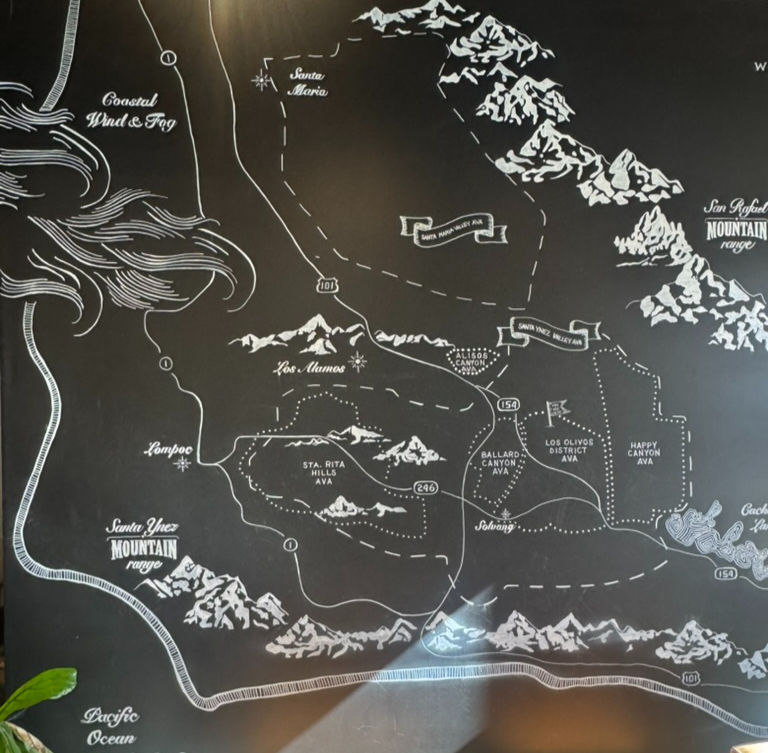
Gasca draws fruit from several AVAs throughout Santa Barbara County, each bringing its own climatic voice to the wines.
Santa Rita Hills
Close to the Pacific Ocean, this AVA is defined by cool marine winds and fog. The climate produces Burgundian-leaning Pinot Noir and Chardonnay with vibrant acidity and tension, as well as minerality that you can feel as pressure as much as flavor.
Ballard Canyon
Known for its dramatic diurnal temperature swings, Ballard Canyon has become one of California’s most compelling homes for Rhône varieties, especially Syrah and Grenache.
Santa Maria Valley
One of the coolest growing regions in California, producing Pinot Noir that is darker, richer, and more structured than many coastal expressions.
Los Olivos District
A Mediterranean climate allows for broader stylistic expression of Cabernet Sauvignon, Sangiovese, and Syrah all of which thrive in this terroir.
Happy Canyon
Warmer and drier than its neighbors, Happy Canyon is known for Bordeaux varieties and a more generous expression of Sauvignon Blanc. Story of Soil ages its Sauvignon Blanc for about ten months in a combination of stainless steel and neutral French oak, resulting in a wine layered with orange blossom, grapefruit, cantaloupe, and lemon zest. The acidity is mouthwatering, less austere than a classic Sancerre, yet less tropical than many New Zealand examples.
Alisos Canyon
Established in 2020, this AVA sits between the Santa Maria and Santa Ynez valleys and is sometimes described as having a “Goldilocks” climate, not too hot, not too cool. The conditions are ideal for Rhône varieties such as Syrah, Grenache, Viognier, and Cabernet Franc.
One of the most compelling vineyard sources is Larner Vineyard, a founding site of the Ballard Canyon AVA. Among Rhône-focused producers, Larner has earned a reputation for Syrah that seems almost perfectly aligned with the region’s soils and climate.
The resulting wine delivers classic Rhône-like notes of olive tapenade, roasted bacon, blackberry, black plum, clove, violets, and dried herbs.
But the pinnacle of our Story of Soil experience came later that evening at Finch and Fork.

The winery collaborated with Finch & Fork, a celebrated restaurant in the Kimpton Canary Hotel in Santa Barbara, for a long-table chef’s dinner that felt both elegant and warmly communal.
Locals gathered shoulder to shoulder around a single table as dishes and wines moved through the room in an easy rhythm.
Root Vegetable Tagine and Moroccan tabbouleh were paired with Fiddlesticks Vineyard Grüner Veltliner.
Grilled gai lan arrived alongside Martian Ranch Gamay, a wine that danced with freshness and spice.
Then came Hasselback butternut squash paired with the Larner Vineyard Syrah, its savory depth wrapping beautifully around the caramelized edges of the dish.
The room buzzed with conversation, laughter, and that particular kind of quiet joy that emerges when food, wine, and people align.
By the end of the evening, we left with a feeling of wholesomeness, of having experienced something authentic and grounded.
We understood a little more about the sense of place and about the craft required to coax character from small vineyard sites.
Terroir may sometimes sound passé among the oenophile elite.
But it remains the compass that guides how we understand wine.
Living in Oregon, I often hear people say Pinot Noir is their favorite wine. And then I ask a simple question:
Which style?
With nearly 900 Pinot Noir producers in Oregon alone, the answer can reveal just how much the land shapes the glass.
Because soil matters.
Story matters.
And when the two merge, something quietly beautiful happens in the world of wine.
Cheer,
Michael Perman, Sommelier
C'EST WHAT? Wine and Sensory
Lake Oswego, Oregon


